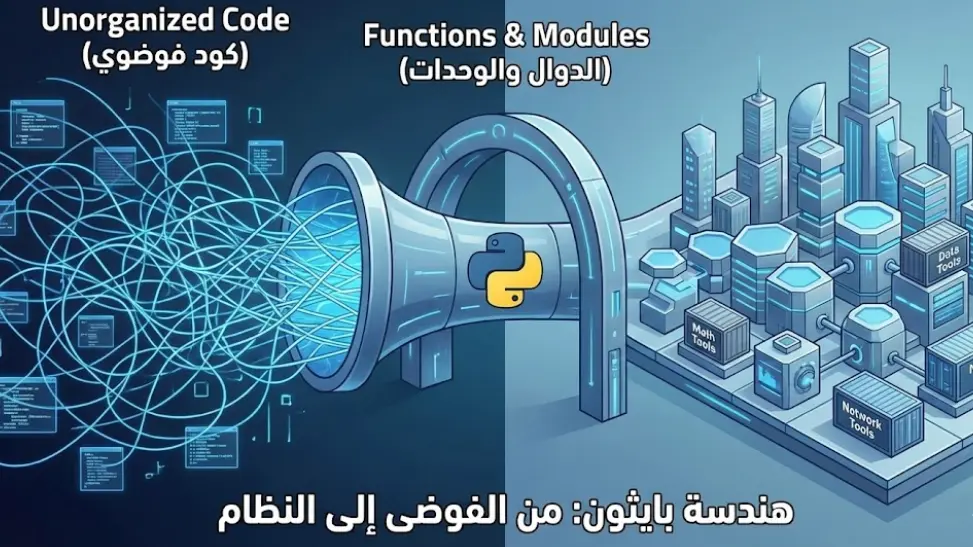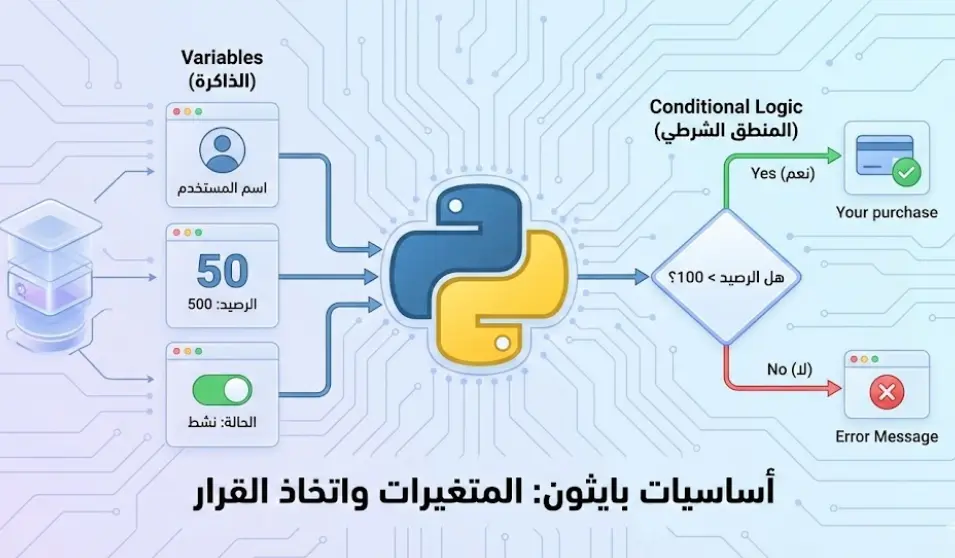
Welcome to the penultimate stop of our foundational journey. In our previous article, Engineering Chaos: How "Functions" and "Modules" Turn Scattered Code into Powerful Python Systems, we learned how to organize our tools and programming commands into neat boxes. We became proficient at dealing with "actions" (Functions) and "information" (Variables) separately.
But the real world doesn't operate in this disconnected way. In reality, things carry their characteristics and actions together. A "Car" is not just a list of data (color, speed, model) separate from a list of actions (move, stop, turn). A car is a single entity that integrates data and actions.
Today, we will make the biggest intellectual leap in the programming world. We will move from writing procedures to execute tasks, to "modeling the real world" inside the computer. This paradigm is called "Object-Oriented Programming" (OOP). It is the standard approach for building most of the complex digital systems we see today, and a key part of our vision at MegoVerse to enable smart digital transformation.
The Conceptual Leap: From "Action" to "Entity"
Until now, we've been thinking procedurally: "Take this data, and apply this function to it." In Python OOP, we start thinking differently: "Let's create a digital entity that represents this real-world thing, holds its own data, and knows how to behave."
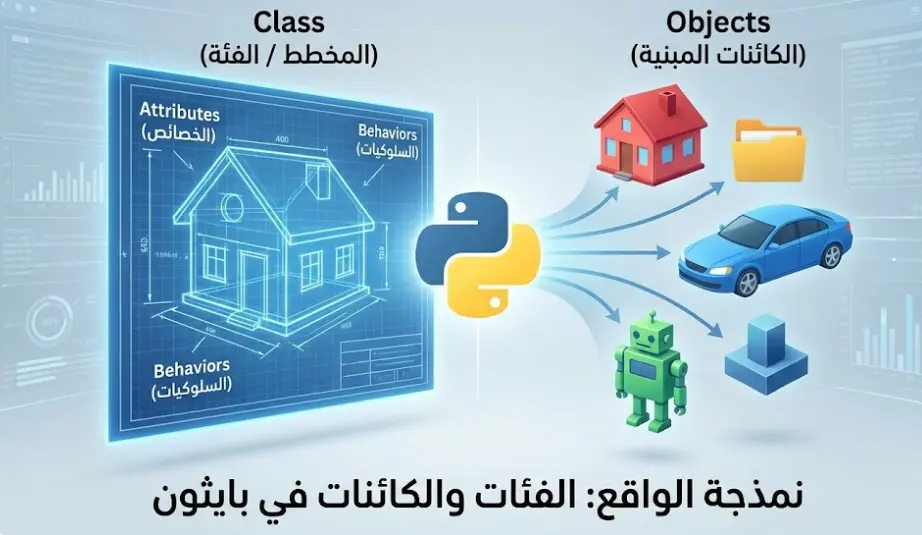
To understand this, we need to grasp two core concepts: the "Class" and the "Object." The best way to understand them is through the analogy of the "Architectural Blueprint" and the "Building."
1. The Class: The Blueprint
Imagine you are an architect who wants to build a residential complex. Before laying a single brick, you must draw an "architectural blueprint." This blueprint defines the general rules:
- Attributes (Characteristics): Every house built based on this blueprint must have a color, a number of rooms, and a specific area.
- Methods (Behaviors): Every house must contain operable systems, like a lighting system that can be "turned on and off," and an air conditioning system whose "temperature can be set."
In Python, this blueprint is the "Class." It is not a tangible thing; it is just a "definition" or a "template" that describes how something should look and behave. You don't live in the paper blueprint, but you need it to build the house.
2. The Object: The Actual Building
Now, construction begins. Using this single architectural blueprint (the Class), you can build dozens of real houses.
- The first house (Object 1) might be "blue" and have an area of "200 sq meters."
- The second house (Object 2) might be "white" and have an area of "350 sq meters."
Each of these houses is an "Object." It is a live, actual instantiation of the blueprint. They all share the same basic structure (the same Class), but each has its own specific data that distinguishes it from others.
Why is Python the Ideal Environment for Learning OOP?
This might sound philosophical and complex, and here lies Python's genius. In many older programming languages, applying this concept requires writing a lot of complex, mandatory boilerplate code. But in Python, it's different:
"Everything is an Object"
Python's core philosophy is that everything you deal with is actually an "Object" built from a specific "Class," even without you realizing it:
- When you write the number
5, Python treats it as an object created from the "Integer Class," which comes ready with properties and behaviors. - When you write the text
"Hello", it is an object from the "String Class," carrying with it ready-made tools (methods) like "convert to uppercase" or "search for a letter."
What does this mean for the learner? It means you have been using object-oriented programming since your very first day in Python without knowing it! Transitioning to creating your own classes and objects in Python is a very natural and smooth step because the language is designed to work this way from the ground up. It doesn't force this pattern on you, but makes it the easiest and most intuitive path for building large systems.
Conclusion: Thinking Like a Professional Software Engineer
Moving to Object-Oriented Programming (OOP) is not just learning a new feature in the language; it is a radical shift in how you think about problem-solving. Instead of thinking about "solution steps," you begin to think about the "component elements of the problem" and how they interact with each other.
This paradigm is the foundation for building massive, scalable software systems that are easy for large teams to maintain.
Ready to master this radical shift in thinking?
Object-Oriented Programming is the key to professional software engineering. Don't just read about it—apply it hands-on. Join our Intensive Python Live Workshop to gain the practical skills needed to build scalable systems using OOP principles.
Its strategic importance is similar to adopting unified architectures to ensure a seamless user experience across different platforms, which we explore in our article on Unified UX Architecture.
What remains? We've learned the basics, then organization, and today, modeling. In the fifth and final article, we will bring all these pieces together. We will take a panoramic look at "Real-World Python Applications" to see how these concepts are used to build websites, analyze big data, and create artificial intelligence.
For more articles explaining complex technical concepts in a simplified manner, always follow us on the MegoTech blog.