Welcome to the third stop on our journey in learning Python. In our previous article, Beyond the Code: How "Variables" and "Conditional Logic" Bring Software to Life, we got acquainted with the fundamental building blocks that give a program its "memory" (Variables) and "decision-making capability" (Conditionals). We now possess the necessary bricks and mortar for construction.
But, can you build a skyscraper simply by stacking bricks on top of each other without a plan? Of course not. The result would be a chaotic, unstable structure that is impossible to maintain or expand. This is exactly what happens to beginner Python programmers when their projects start to grow and become more complex.
Stop the chaos before it starts.
Building scalable systems requires a solid foundation. Master the art of organized coding from day one by joining our Intensive Python Live Workshop, where we guide you from basics to engineering mindset.
Today, we shift our mindset from "text editor" to "systems engineer." We will learn about the conceptual tools in Python that allow us to organize our ideas, intelligently reuse our efforts, and build scalable software systems, which is the core of what we strive for at MegoVerse to deliver sustainable digital solutions.
First: The "Don't Repeat Yourself" (DRY) Principle and the Rise of "Functions"
Imagine you are writing a Python program to analyze sales data. In ten different places in your program, you need to perform the same complex task: calculating net profit after deducting taxes and shipping. If you copy and paste the same solution steps in all ten places, you are committing one of the biggest sins in programming.
Why? Because if the tax law changes tomorrow, you will have to search through your program and modify the code in ten different places. The probability of forgetting one or making a mistake is almost certain.
The Python Solution: Functions as "Specialized Skills"
In Python, the solution is to use "Functions." Think of a function as a "specific skill" or an "action" you teach your program. Instead of repeating the profit calculation steps, you group these steps once and give them a clear name, like "calculate_net_profit".
Now, anywhere in your program you need this operation, you don't rewrite the steps; you simply order Python: "Execute the 'calculate_net_profit' skill on this data."
Why is this important for a Python learner?
- Applying the DRY Principle: Python encourages the (Don't Repeat Yourself) principle. Write the logic once and use it everywhere.
- Readability: Python is designed to be readable. When you use functions with clear names, reading the code becomes like reading a story: "Read the data, then 'clean it', then 'calculate profits', then 'send report'". This shift towards Abstraction is the foundation for building stable and fast systems, as we discuss in enterprise web development strategies in Accelerating Enterprise Web Development.
Second: The "Toolbox" Strategy (Modules)
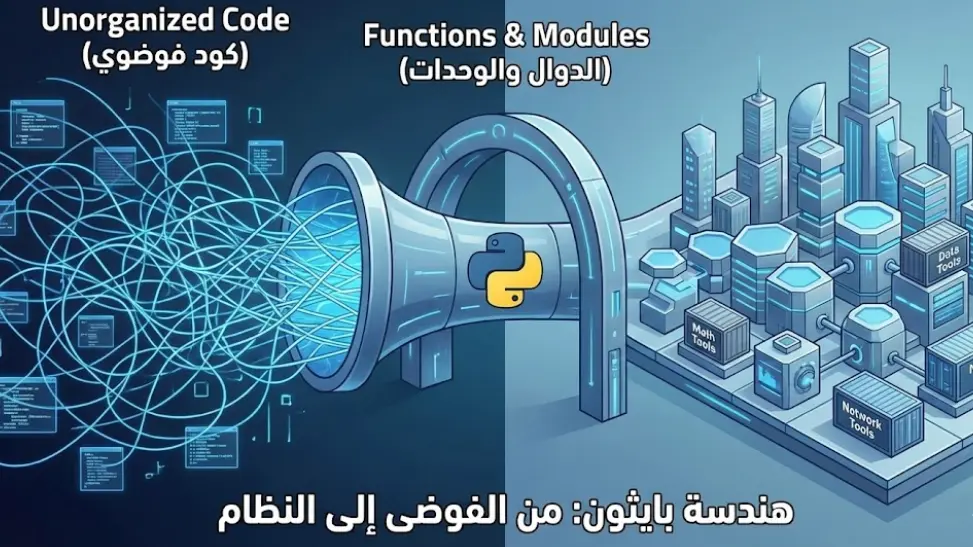
Once you master using functions, you'll find that your Python program now contains dozens or hundreds of these "little skills." If you leave them all scattered in one long file, chaos returns. How do you find the skill you need amidst this crowd?
The Python Solution: Thematic Organization using "Modules"
Here comes the organizational power of "Modules" in Python. Think of them as specialized "toolboxes" or chapters in a book. Instead of throwing all your tools into one pile, you put math tools in one box, file handling tools in another, and internet connectivity tools in a third.
In Python, a module is simply a way to group related functions together under one umbrella.
Python's Secret Weapon: "Batteries Included"
This is a major competitive advantage of learning Python. The language's philosophy is based on the "Batteries Included" principle. This means that when you install Python, you don't just get the language; you get a massive "Standard Library" along with it, filled with ready-made "toolboxes" built by experts.
- Do you need to perform complex mathematical operations? Don't reinvent the wheel; there is a ready-made module for that in Python, just "import" it and use its tools.
- Do you need to deal with different dates and times? There is a ready-made toolbox for that.
- Do you need to read CSV or Excel files? There are ready-made modules for that.
Learning Python doesn't just mean learning how to write code, but learning how to "leverage" this rich ecosystem of ready-made modules to build powerful applications incredibly fast, without needing to start from scratch.
Conclusion: Shifting to the Engineering Mindset
In this article, we didn't talk about syntax; we talked about the "way of thinking" in Python. The transition from writing sequential commands to designing systems based on smart functions and organized modules is the qualitative shift that turns you from a mere code writer into a software engineer capable of handling large projects.
This structural organization is the basis that allows programming teams to collaborate and makes code maintainable in the long run. These organizational principles are similar in strategic importance to adopting unified architectures to improve user experience across different platforms, a vital topic we explore in Unified UX Architecture.
What's next in our journey to learn Python? Now that we've organized our tools, it's time to jump to the most powerful and dominant paradigm in modern programming: "Object-Oriented Programming" (OOP). In the next article, we will see how Python enables us to represent the real world (like employees, products, bank accounts) inside our programs as smart digital "objects" that interact with each other.
To stay updated on the latest technical insights in the world of programming and digital transformation, we always invite you to explore our blog at MegoTech.