Welcome back to our series exploring the world of Python. In Article 1: Introduction to Python, we discussed the immense popularity of this language and why it is the optimal strategic choice in the era of digital transformation. Today, we take a deeper step, not to write code, but to understand the "philosophy" and "mechanisms" that make code work.
When we use our daily applications, whether they are social media platforms, banking apps, or even video games, we only see the final interface. But what happens behind these interfaces? How does the application "remember" your name? How does it "know" that your balance is insufficient to complete a purchase? How does it "decide" to show specific content to you and not others?
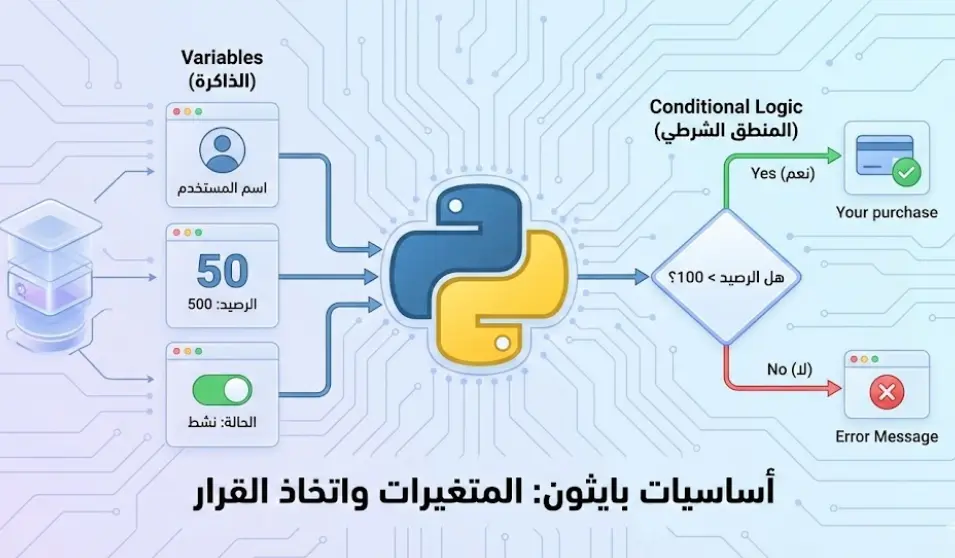
The answer lies in the fundamental concepts we will discuss today from a purely conceptual perspective: managing digital memory (Variables), categorizing information (Data Types), and decision-making (Conditional Logic). Understanding these pillars is the essence of what we do at Welcome to MegoVerse to empower companies to build smart and efficient digital solutions.
First: The Art of Digital Memory (Variables as Information Infrastructure)
Imagine if every program you used suffered from instantaneous "amnesia"; forgetting who you are as soon as you move from one page to another. The user experience would be catastrophic. This highlights the paramount importance of the concept of "Variables."
Beyond their dry technical definition, we can view variables as special "smart storage containers." They are the method by which a program allocates a portion of the device's memory to retain specific information needed later. The practical result of applying this concept is what we see daily:
- Personalization: When a program stores your name in a "variable," it can use it on every screen to greet you, creating an intimate and connected user experience.
- Continuity: In e-commerce applications, the "shopping cart" is essentially a group of variables remembering the products you chose while browsing others. Without this memory, your selections would be lost with every click.
- State Tracking: In games, variables are what save your current score, your level, and the number of remaining attempts. They are the living record of your progress within the system.
Thus, variables are not just lines of code; they are the working memory that gives the program the ability to maintain context and provide a coherent experience.
Second: Why Categorization Matters (The Essence of Data Types)
In the digital world, not all information is created equal. Dealing with a phone number is radically different from dealing with the monetary amount in an account, and both differ from text representing a home address. Here, "Data Types" come into play as a crucial organizational mechanism.
Strictly applying the concept of data types leads to substantial results in software quality:
1. Ensuring Logical Integrity
By defining the data type (is it text, an integer, a decimal number, or a yes/no boolean value), the system prevents illogical operations. For example, the program cannot "add" a username to their date of birth in a mathematical calculation. This strict categorization prevents information chaos and ensures that mathematical operations are performed on numbers, and text processing operations are done on words.
2. Efficiency in Performance and Resource Consumption
Computers handle integers (like a product count) differently and faster than they handle precise decimal numbers (like currency rates or scientific measurements). Choosing the appropriate type for information ensures optimal utilization of device resources, a fundamental principle for maintaining system speed and stability, just as we discuss the importance of platform stability in Web Platform Stability Updates.
3. Accuracy in Sensitive Operations
In financial applications, the difference between using a data type dedicated to precise decimal numbers versus an imprecise one can mean huge financial discrepancies in cumulative calculations. Understanding data types ensures extreme accuracy in fields that cannot afford errors.
Third: The Mastermind (Conditional Logic and Decision Making)
A program that executes commands in a fixed sequence without regarding surrounding variables is a "dumb" program. Programming intelligence begins when the system possesses the ability to make decisions based on inputs, which we call "Conditional Logic."
This concept is the backbone of any dynamic interaction. It is simply the ability to say: "If this happens, do this; otherwise, do something else." We see the practical results of this logic everywhere:
- Access Control and Security: The direct result of the logic "If the password is correct, allow entry; otherwise, display an error message" is protecting user data. This is the simplest yet most vital form of conditional statements.
- Adaptive UX: Websites that change their layout based on your device (mobile or desktop), or apps that switch to "dark mode" based on the time, all rely on conditional statements that scan the surrounding environment and decide to adjust the interface.
- Smart Recommendation Systems: Behind the scenes, platforms like Netflix or Amazon use complex conditional logic: "If the user watches action movies, AND if their rating for them is high, THEN suggest new movie X." This logic is what creates a personalized experience for every user.
- Graceful Error Management: Good programs anticipate problems. Conditional logic allows the program to check for a problem before it escalates: "If the internet connection is lost, do not crash, BUT display a gentle message to the user and show locally saved content."
Conclusion: Towards Building "Smart" Systems
Today, we stepped away from writing code to get closer to the essence of programmatic thinking. We saw how variables are not just names, but the system's memory; that data types are not just technical classifications, but a guarantee of information integrity and efficiency; and that conditional statements are not just commands, but the brain that gives the program the ability to adapt and make decisions.
Understanding these results and concepts is the most important step before diving into the details of syntax. These fundamentals pave the way for building complex and stable systems.
Ready to move from concepts to practice?
If you want to master these fundamentals hands-on with expert guidance, join our Intensive Python Live Workshop. It's the perfect next step to turn this theoretical knowledge into practical skills.
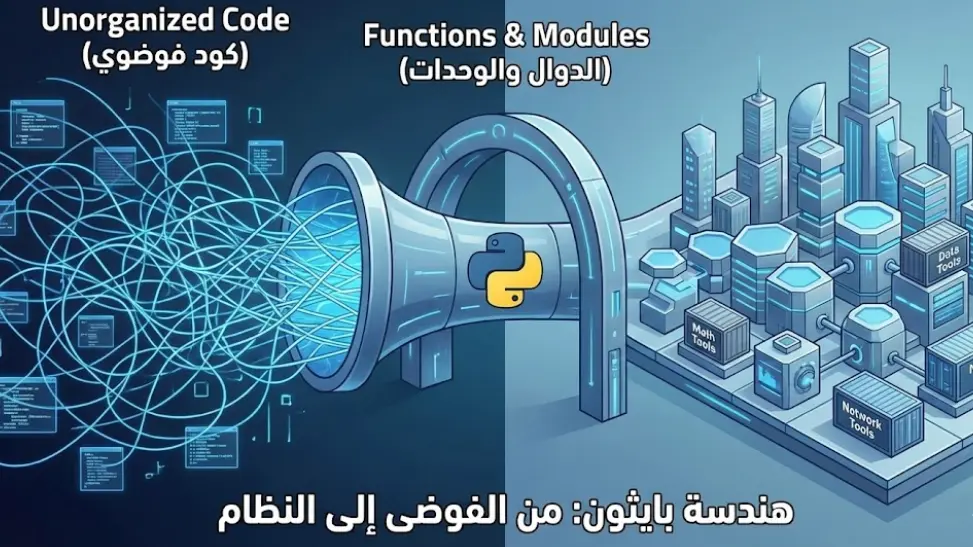
In our next article, we will move to another core concept in modern software engineering: How we organize these ideas into reusable building blocks (Functions and Modules), an organizational principle similar in importance to adopting unified architectures to improve user experience across different platforms, as we review in Unified UX Architecture.
To stay updated on the latest technical trends shaping the future of software and business, we always invite you to explore our blog at MegoTech, and get to know the team of experts leading this innovation.